
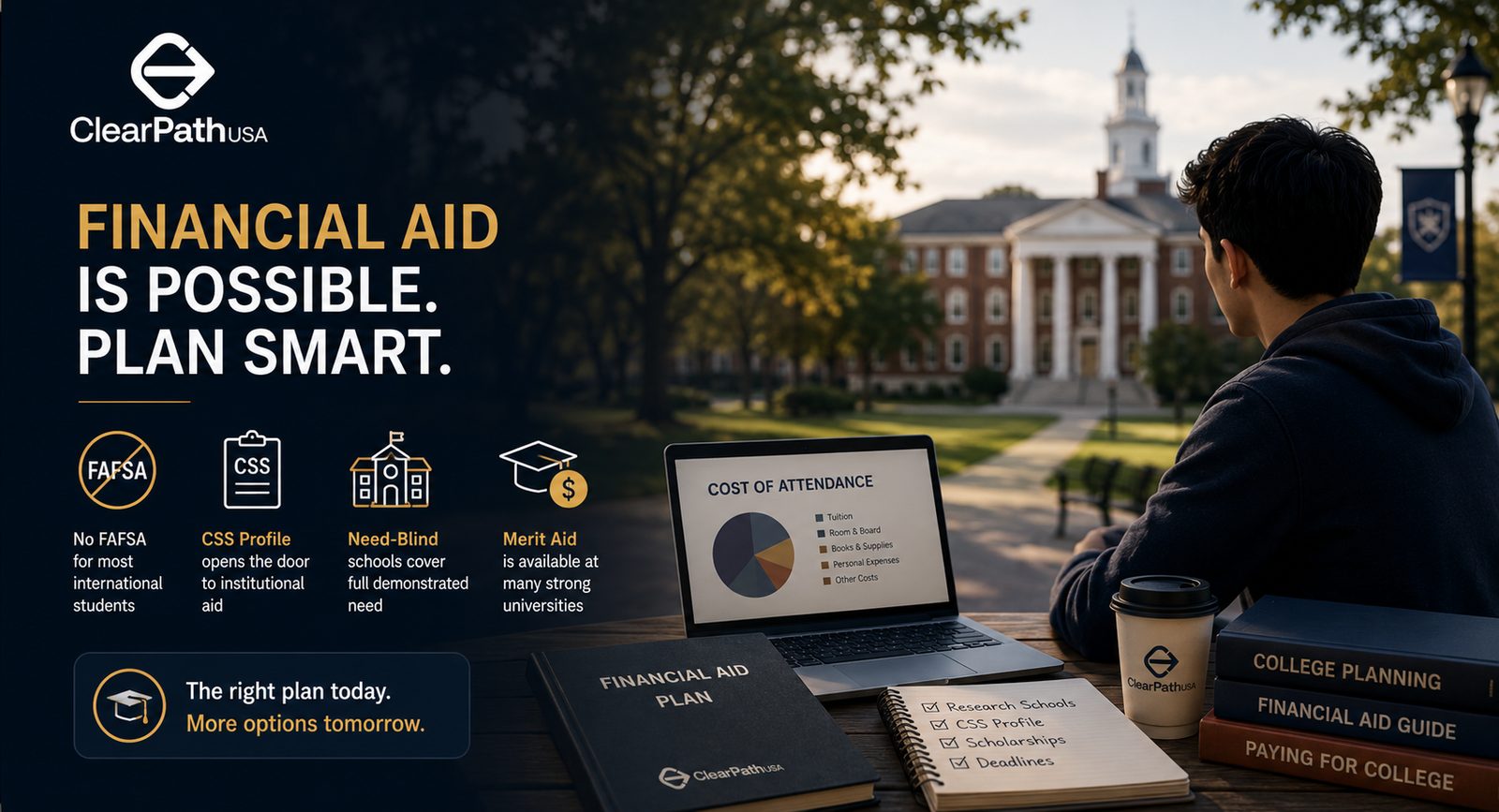
This is one of the first questions we hear from families exploring U.S. colleges, and the honest answer is: it’s complicated, but not hopeless. Here’s how financial aid actually works for international students, and where the real opportunities are.
The short answer
International students on an F-1 or other temporary visa cannot access federal financial aid. That means no FAFSA, no Pell Grants, and no federal student loans. Those programs are reserved for U.S. citizens, permanent residents, and a small group of other eligible non-citizens, like refugees or asylees. But federal aid isn’t the only kind of aid out there, and plenty of international students graduate from U.S. schools with significant institutional support.
Why FAFSA doesn’t apply to you
FAFSA determines eligibility for federal aid, and federal aid is funded by U.S. taxpayers for U.S. citizens and permanent residents. If you’re on an F-1 visa, you generally won’t have a Social Security number tied to work authorization, and you won’t qualify to submit a FAFSA at all. This trips up a lot of families who assume “financial aid” always means the FAFSA process they’ve heard about from friends with kids in U.S. high schools.
Where the real money comes from: the CSS Profile
Most private colleges use a separate form called the CSS Profile to award their own institutional aid, funded by the school’s endowment rather than the federal government. This is where international students actually have a shot. Hundreds of colleges use the CSS Profile to distribute need-based scholarships and grants to admitted students, including those on visas, so filling it out accurately and on time matters just as much as your application itself.
Need-blind vs. need-aware: know the difference
This is the part that catches families off guard. Most U.S. colleges are “need-aware” for international applicants, meaning your ability to pay can factor into the admissions decision itself. A small number of schools are “need-blind” for international students too, meaning they evaluate your application without looking at your financial need at all, and separately commit to covering 100% of demonstrated need for every student they admit.
Right now, that group includes Harvard, Yale, Princeton, MIT, and Amherst College, historically the most consistent members of this list. Dartmouth joined in 2022, and Brown became need-blind for international applicants starting with students entering in 2025. These schools are also some of the most competitive in the country, so getting in is the hard part, but if you do, the financial picture can be transformative: full-need schools cover the gap between what your family can pay and the total cost of attendance, often without requiring loans.
What “full need” actually covers
Being admitted to a full-need school doesn’t automatically mean a free ride. Your family’s contribution is still calculated based on income, assets, and circumstances, and can range from very little to a substantial amount. What it does mean is that once that number is set, the school fills in the rest through grants and, at some schools, a campus work-study job, rather than leaving you to find private loans or turn down the offer.
Beyond the Ivy League
If elite need-blind schools aren’t a realistic target, or you want backup options, look at merit scholarships instead of need-based aid. Many strong universities offer merit money to international students based on academic record, test scores, or specific talents, regardless of financial need. These awards tend to be more predictable to plan around, since they’re often listed publicly with clear GPA or test score thresholds rather than a black-box need calculation.
Bottom line
Federal aid is off the table for most international students, but that doesn’t mean you’re paying full price everywhere. The CSS Profile is your gateway to institutional aid, a handful of elite schools offer genuinely need-blind admission with full-need funding, and merit scholarships fill in the gaps at many other strong universities. The families who plan for this a year or two ahead of applications, rather than discovering it during senior year, end up with far more options on the table.
This article is educational and general in nature. Financial aid policies vary by school and can change year to year, so always confirm current details directly with each college’s financial aid office.
Our College track walks through the full application, visa, and financial aid process step by step. Get in touch if you want help mapping out a realistic list of schools and aid options for your situation.